Trini is the magic number…
Yoga seems to be getting it in the neck from all sides these days. Traditionalists say its message has been diluted beyond recognition while the health, thrill and attention seekers are moving on. It’s time to talk about what dynamic, modern - day yoga really has to offer. Astanga’s best kept secret has always housed its most tangible, life - enhancing benefit. Hands up who knows how to tik - tok but has never heard of the tristhana?
Myths and Heroes
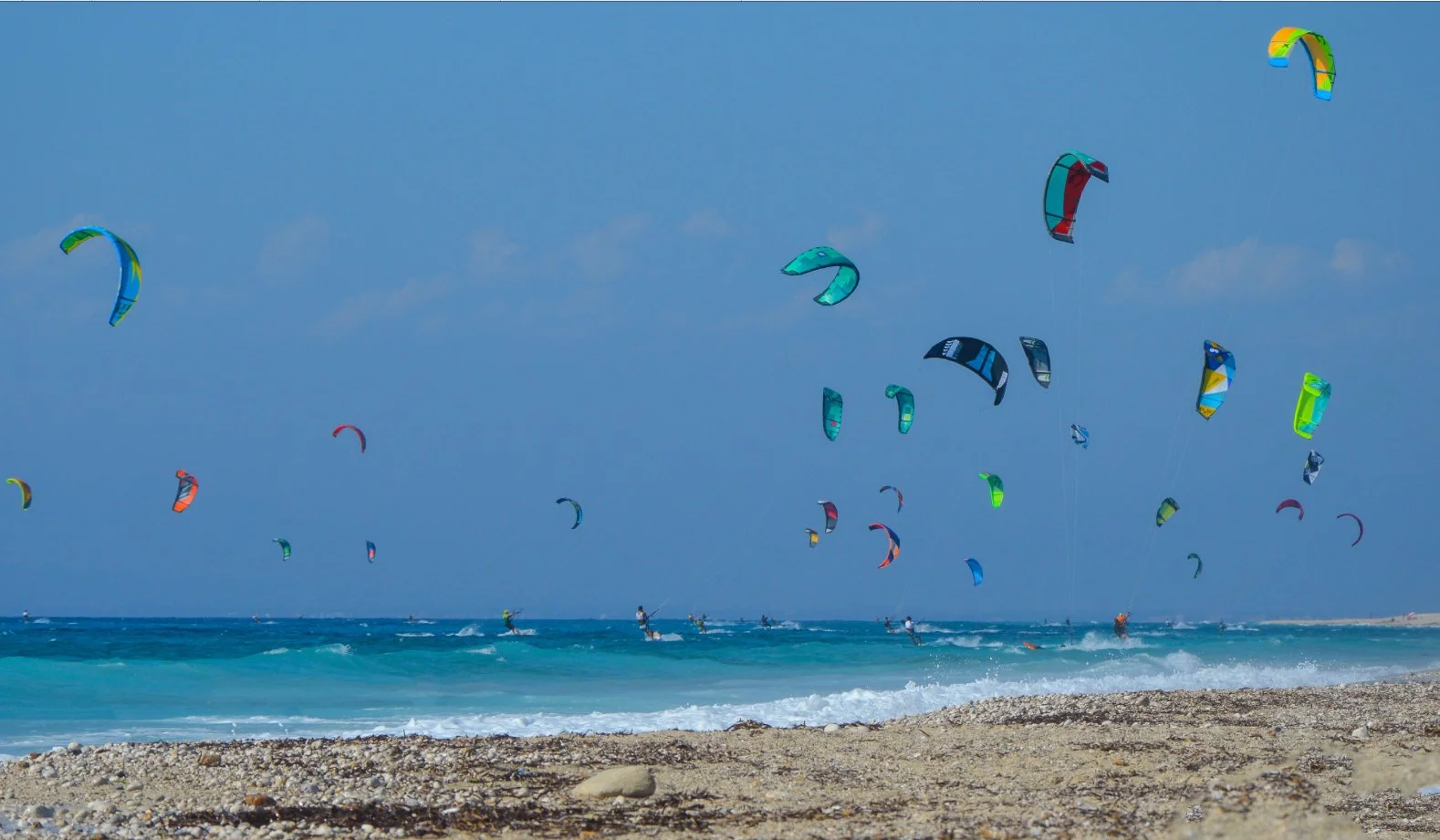
Early in the morning on Kite Beach, before the breeze starts to stir, the water is calm and clear. Time for a swim across the dazzling turquoise bay before the wind and the waves begin to rise.
One by one the kite surfers arrive. As I dry off from my swim I sit, fascinated by the spectacle unfolding before me. First just a few kites - larks like me - then more and more until the sky is festive. The kites dip and dance in the breeze, like the flags above a Glastonbury audience.
But their gentle rise and fall belies what is happening on the water. Cutting through the waves at breathtaking speed are the foils and boards of the daring surfers. They race, they fly… they seem to hover above the shimmering sea. They cover astonishing distances between their turns, some appearing to take off, suspended for a moment in mid-air. Others seem to have mastered the art of slowly pirouetting before making wave - fall again.
I can sit and watch them for ages. Set against the rocky backdrop of Paros in the distance, framed by the impossible blue of the sea and the sky, it’s easy to imagine mythical heroes in their place. The offspring of Sea Nymphs and Olympians. As if the whim of a deity might suddenly turn them into an army, racing across the water to do their bidding.
When my reveries subside I wonder if I should give kitesurfing a try.
These are idle thoughts. I know deep down that I probably never will. Ten or twenty years ago things might have been different. Long term, no sport has ever delighted me as much as swimming. I enjoy the lack of equipment required, and the relative spontaneity with which it can be enjoyed.
On Naxos I spend cumulative hours in water with a hue I have not experienced before. Blue beyond blue, shifting imperceptibly at various depths. Its colour changes again as the sun tracks across the sky. I can’t decide which time of day is my favourite, although I do love a morning swim. Then I will plough across the bay; later on I might float idly or dive amongst rocks and reefs, unencumbered by snorkel or fins.
The water has been my lifelong happy place and, in all that time, nothing has ever beaten the sea.
And then there is my yoga practice. Even less dependent on conditions than a swim. Over many years I have rolled out my mat pretty much wherever there’s been enough space (and sometimes where there hasn’t). My practice is not so much a place I go to as a longtime travel companion.
I arrived on Naxos at the start of my fifty-eighth journey around the sun, in my twentieth year of saluting it.
Watching the kites and thinking back to the start of that yoga journey, I am reminded of my first impressions of the practice. Elements of it actually looked - and felt - like something akin to an extreme sport. I soon discovered that what appeared to be simple balancing postures, where my body was only inches above the floor, felt like tightrope walking. There were even poses that made me feel like I could fall over… when I was already sitting down.
While I struggled with all of this, I was aware that bodies around me literally seemed to be taking flight. Hovering, even floating. Many seemed to possess an effortless strength. It was difficult to comprehend and - if I’m honest - the thought of maybe one day being able to “do” any of it was hugely appealing.
Not that this was why I kept going.
The other most beguiling aspect of practice in those early days was being allowed to work at my own pace. With hindsight - having guided many beginners over the years - I think this is a small but crucial step towards a long-term practice: a realisation that the journey is all your own. You’re not learning to practise like anybody else in the room. Not the mythical-looking heroes around you… not even your teacher.
This is because internal focus is hardwired into the style of yoga that I practise and teach. The mind and the eyes may be tempted to wander around the room, contrasting and comparing, but sooner or later this practice requires your full attention. Or, to be more precise, you are invited to divide your full attention equally
between three elements.
Three is the magic number.
Tristhana is a Sanskrit word which means “three dwelling places”. Trini is three, sthan is place.
The three abodes of Tristhana are breath, posture and visual focus.
It sounds incredibly simple and it is, up to a point.
Imagine a tripod on which to fix your practice, the way a photographer might steady a camera. Then you have a useful image to work with, as well as an understanding of how fundamental each leg is: remove one and the tripod falls over.
Right at the centre of the tripod is posture, known in Sanskrit as asana. Inherent to the asana practice of modern-day Astanga Yoga - I’m going to call it Mysore style - is vinyasa.
This is another Sanskrit word that has become almost entirely associated with movement or transition in popular culture but actually refers to placement. Placing a movement onto a breath is a vinyasa. Counting a number of breaths in a held position is also vinyasa. So is placing a group of postures in a specific order, like a series. So is placing your mat in a yoga shala and placing yourself on the mat… and so on, and so on.
The literal translation of vinyasa is ‘special rules for placement’, which is a lot less catchy than the Sanskrit. I like to think of it as ‘ritualised action’.
Breath and visual focus support this ritualised action. All vinyasa - whether moving or static - have a breath (or a number of breaths) applied to them. All vinyasa - whether moving or static - have a prescribed looking place, known in Sanskrit as dristi.
Some dristi involve extremities such as the hands and feet, the thumbs and the toes, especially when one extremity makes contact with another. Others, such as the tip of the nose, the space between the eyebrows or the navel, encourage internalised focus or are deeply grounding.
I’ve already mentioned those seemingly simple postures that make us feel like we’re going to fall flat on our faces the minute we try them. The application of dristi obviously helps us find physical balance in such situations, but its use throughout the practice also has a powerful effect on the mind by guiding concentration.
The breath is the biggest sound in a Mysore room, and with good reason. It’s arguably the most important part of the practice.
The technique is quite simple. All breathing is done through the nose if possible, as it is easier to control this way. Inhalations and exhalations are regulated to make them equal in duration and intensity. A sound is also given to the breath by gently closing the glottis so it can be internally listened to and counted.
This is not easy when applied to vinyasa and - for beginners at least - regulation is more important than sound.
The first hurdle for most people is equalising inhalations and exhalations. It’s easy to over-emphasise exhalation, often associated with relaxation, especially when bending forward. Conversely, most of us have a tendency to shorten our inhalations when an asana is difficult or intimidating. This can manifest in twists or backbends.
Steadied breath smoothes our passage through the practice. This skill can be taken off the mat and into daily life. When we are agitated by difficult or scary situations, the breath has a tendency to become rapid, shallow and irregular through an involuntary response of the autonomic nervous system. Habitually slowing and regulating our breath can delay or even change this default setting, steadying us for whatever comes our way.
So that’s Tristhana in a nutshell.
If it sounds a bit humdrum, it really isn’t.
The ingrate mind, its biggest beneficiary, is also its greatest obstacle. Here’s a brief illustration of how this might play out on any given day.
You roll out your mat and start to move. You make spaces with the body and breathe into these spaces, listening to the quality of the breath and taming it if necessary. All the while you direct your gaze to very specific points.
This alone requires a lot of concentration, leaving the mind fewer opportunities to wander.
But of course, it wants to wander. It actually wants to charge off in several directions, all at once.
“I’m hungry,” it’ll say. “This is hard, I can’t do this. I’m tired. How much longer? That email so-and-so wrote yesterday was out of order. How the hell am I going to reply? I don’t have time for this. I look stupid in this pose… it’s Mum’s birthday this weekend. I must get a card.”
The beauty of Tristhana is the brevity of the list of things to coax your wandering mind back to. Each time you practise you are offered the same opportunity.
At some point you start knowing what to do without consciously telling yourself. In those moments a new and quite intense kind of calm descends. You might feel inexplicably good after witnessing these moments.
You might also start to develop a new way of witnessing the spaces you occupy off the mat, breathing into those moments when you could do with an anchor. Observing them without too much internal chatter or the need to react.
This probably sounds a bit daft for someone who has loved swimming since they were knee-high, but learning to regulate my breath, on the move, out of water, was revelatory to me.
And it got me hooked.
The “Breathe, Move, Look” thing.
If you know me, you’ve heard this part a squillion times. Apologies, I’ll make it quick (you could always pretend you’re bingeing a Netflix series and scroll down to ‘skip the recap’).
Twenty-ish years ago I was a chef in transition: shifting from working for other people to owning a restaurant. As we neared the opening date I began to experience levels of anxiety which threatened to derail the project for me.
I had battled with anxiety before but hitherto my ‘coping mechanism’ had been either outright denial or suppression. You know: really healthy, bloke stuff.
At this time, however, I realised there was a whole bunch of other people who would be adversely affected by working with a miseryguts. So I decided to really, properly, do something about it.
Yoga was the suggestion of a trusted friend. I was deeply sceptical at first, but my very early attempts to find a class I could regularly attend led me swiftly to Mysore-style practice and Astanga Yoga London: the shala that I am still deeply involved with to this day.
It was either fate or happenstance. It doesn’t matter which.
In this space I felt very nurtured from day one. I learned slowly. For several months my practice was based almost entirely on standing postures. It was the only appropriate way for me to grow a meaningful practice alongside my crazy schedule.
It seemed extraordinary at the time that I was complementing sixteen-hour shifts on my feet with more standing up, but it also made sense. Moreover, it was short and simple enough to try at home when I couldn’t get to the shala.
It was not easy. It was hard. Shockingly hard, especially on my stiff, aching legs.
But “the breathe-move-look thing”, which is what I called it at the time, was really working.
My general outlook was changing quite dramatically. It felt like medicine.
It feels the same way today.
A few months in, I experienced a key moment. I was at work, in the middle of an unexpected surge in customers, on an already busy shift. We used to call it ‘getting slammed’. My mind was racing and I could tell that any minute my chest would start tightening. The familiar, dreaded onset of a panic attack.
Out of nowhere a voice in my head began instructing me how to breathe and move, very deliberately, through everything I needed to do, just when I needed to do it. The voice was mine, but it was eerily calm and measured.
At one point, when my head would once have been all over the place, I found myself thinking, “I could hear a pin drop up there right now.”
I am likely to tell people something of this story when I’m asked if I’m a strict teacher or if my practice is “traditional”. If you’re associated with a shala like Astanga Yoga London, you get asked this a lot.
I answer that I am a “Tristhana-first” teacher because I’m a “Tristhana-first” practitioner.
Tristhana First.
Some people who come to practise with me for the first time have heard of ashtanga (with an h). Lots more have heard of vinyasa. Loads of them have been to led classes of various descriptions and picked up nuggets of information about bandhas, jump backs and chaturangas and yada-yada-yada.
Tristhana? Not so much.
More’s the pity, because it is one aspect of the method that can be most easily conveyed and is accessible to all comers. It is almost entirely missing from the popular discourse about this much misunderstood practice.
The reasons for this are complex. They also explain why Mysore-style Astanga is a tricky proposition for yoga studios in the commercial setting.
Like many other forms of Hatha Yoga in the Global North, Astanga earned its moment in the sun towards the close of the twentieth century, as an exemplar of practices which blended physical health with “mindfulness”.
A lot was said about how this practice could make you stronger and leaner whilst conveniently working as a daily detox and a path to enlightenment. As if that wasn’t enough, it was authenticated by a direct line to the ancient sage Patanjali, who had mentioned it in his Yoga Sutras thousands of years ago.
A lot was said about how to meet the physical demands of the practice in order to become this strong, lean, calm, disciplined and detoxified version of yourself.
Much of what was said must have seemed quite far-fetched to outsiders. It was intimidating to newcomers and infuriating for sceptics and naysayers.
The truth is that, like most physical activities, if you want Astanga Yoga to make you stronger and leaner you need to do it a lot. It is a far-from-convenient means by which to keep fit, requiring levels of commitment that most people can’t or don’t want to give it…for perfectly understandable reasons.
That, of course, is why a whole raft of more convenient or fun-to-try versions have manifested in its wake. You could call some of these classes (complete with groovy soundtracks and even groovier leggings) yogacise, which isn’t a slur.
There are loads of people who never want to punch anyone but enjoy boxercise. Does this make boxers cross? I doubt it.
Perhaps there is a stage in the popularisation of all disciplines when disquiet is felt by those who are witnessing or participating in the process.
Yoga (or, to be more precise, yogasana) inhabits this uneasy space right now.
Asana, a word that - in Patanjali’s day - meant ‘seat’, is currently used to describe a myriad of standing, inverted, supine or dynamic postures. Would this development horrify the sage? I suspect he’d be no more startled to discover standing asanas than to see his sutras in print.
A great deal of energy could be expended on worrying about the modern conflation of asana with yoga. We are where we are: Thousands of years after either word was uttered, a person approaching yogasana as a means to living well might find themselves becoming curious about its origin story. Or they might not.
If Tristhana is emphasised as both the foundation and the main benefit of yogasana practice, it naturally aligns modern-day versions with their origin story without pushing the point. The list of benefits is not far fetched and - crucially - applies equally to practitioners of every level.
In fact, true beginners may even be at an advantage.
Although Tristhana is not exactly easy at any stage, it’s possible that someone with less asana experience might find it more straightforward than a person trying the Mysore method after doing lots of led classes.
Any teacher reading this will be familiar with the scenario: a Mysore beginner comes to their first class with “ashtanga experience”. They may feel held back if advised to keep their initial sessions shorter and simpler than the physically demanding classes they are used to. They may be at pains to prove what they already know or are able to do. They might have charts to prompt them, believing that advancement is at least partially achieved through a test of memory.
Tristhana perfectly explains and justifies the slower teaching method of incremental learning.
Repetition of postures and their sequencing over time allows the memory to become embodied rather than intellectual. I often reassure those coming from led-class environments this way. If you try and remember everything from those classes before you start moving, it’s likely to elude you. If you start a sun salute and allow yourself to experience what you remember, without prompts, the results may pleasantly surprise you.
In their initial forays toward self-practice, I encourage everyone to proceed only up to the point where they start needing prompts, and to add only a little more each time they practise after that.
This way they begin to experience and benefit from the true function of the Mysore room, as opposed to an approximation of it.
Sadly, the approximation has become the norm in much of the commercial setting. Nobody wanted their led Astanga classes or Mysore rooms to present as strict, bossy, hierarchical or (God forbid) culty. So a weird hybrid was born where success was defined by ever increasing numbers of attendees. Teaching In these spaces sometimes felt like a frantic game of people - pleasing. Whilst all the time wondering how long it would take your beginners to find out that yogacise was more fun. It was like trying to convince everyone to stay in the library when you all know there’s a party next door. In this setting it was very difficult not to teach people too much, too soon. This tendancy risked cluttering Mysore rooms with dizzying amounts of pre - posture drillls, shortcuts or modifications. None of these things are bad in and of themselves but you had to wonder if anyone was really benefitting from all the accessorization. Apart from maybe LuluLemon.
The truth is that if the practice is learned slowly or at least organically then it doesn’t need embellishing. It also becomes something very precious. It is sustainable. The complex and challenging asana are neither playthings for the extremely able bodied , nor a reminder for everybody else of their limitations. Nothing is insurmountable if neither teacher nor practitioner is pushing an agenda or forcing things in order to get them ‘right’.
The best way to ensure that this isn’t happening with any part of the practice, whether new or established, is to regularly ‘check in’ with the Tristhana: is the breath steady, can the gaze be held?
This approach makes Mysore practice quite unique amongst the many schools of Hatha Yoga. Because although some attention is given to making sure asanas and transitions are safe, the lion’s share of ‘technique’ is focused elsewhere.
If that sounds a little gung-ho or laissez-faire, it helps to visualise the breath and the gaze as the method’s natural safety valves. They stop us from micromanaging our practice with thoughts like, “I should go deeper here” or “this pose could be better”.
The longer I practise and teach Mysore, the more I’m convinced it is thoughts like this which are most likely to cause imbalance or even injury. Not an incorrectly placed foot or a wobbly leg here and there.
Over-emphasis on form and physical technique can render the practice unsustainable if practitioners feel they never get it quite right.
In a process felt on such a deeply personal level by each individual, it’s possible to become discouraged by a raft of issues. There are too many to attempt a full list, but the ones I encounter most are:
Frustration or disappointment from a lack of perceived ‘progression’.
This is most common amongst beginners but it can manifest in longer-term practitioners, too, especially if the approach becomes overly ambitious. Those practising to improve their health or seeking the rather indefinable goal of ‘wellness’ are also at risk of being results-led, which can lead to disillusion if their expectations are not managed.
Feeling compromised by injury or other physical restrictions.
Whether we are prepared to admit it or not, many practitioners have a perceived ‘ideal’ version of our practice, usually related to how strong, energised or flexible we feel on the mat.
Any deviation from this can feel like a setback. The most extreme reaction to this is refraining from practice completely until the setback has receded enough for something closer to the ‘ideal’ to be expressed.
This scenario is further complicated if practitioners believe that working with injuries is not safe or will impede recovery. You can wait - out recovery time from injury but what about the ageing process or a chronic health deterioration?
The truth is that every practice will change, all the time. There is no fixed, permanent or even ideal version. Changes are changes, whatever labels we attach to them. None of them need deprive us of Tristhana.
Feeling self-conscious or guilty if practice is not rigorous, dedicated, spiritual or traditional enough. Struggling with practice - life balance when trying to address this issue.
This is where I am hyper - vigilant about staying in my lane and meeting people where they are at, as opposed to telling them where they could be. There’s a fine but indelible line between encouraging someone and directing them.
I’m happy to talk about my experience of the practice if asked, but only if I believe it will be helpful without coming across as an example to be followed.
One thing which unites all these so-called setbacks is the misconception that there is a perfect version of practice - which, if you think about it, is a bit like saying there’s a perfect version of a human being.
Perfection is elusive and highly subjective. It is a futile goal off the mat and it is not the goal when on it.
One of the biggest misunderstandings about Mysore practice is that it is learned or ‘perfected’ posture by posture.
In fact, it is taught and understood breath by breath.
The Mysore room.
The primary function of the Mysore room is to hold this breathing space. This is the reason for the incredible sound one hears on entering such a space for the first time.
Breath. Punctuated occasionally by low-intervention advice, given sotto voce to one practitioner at a time.
Even the place of the led classes on a Mysore calendar serves mainly as an occasional reminder of the most helpful and expedient vinyasa (the most important of which even seasoned practitioners forget now and then). It is the song of the practice.
This is the reason for the precise recitation of the vinyasa or the rhythmic instructions to inhale and exhale, to look at raised hands or grounded big toes.
You take note of what you’ve forgotten or discarded and, perhaps, apply it to your next self-practice.
It’s not a test of endurance or prowess, although it can be fun to challenge yourself this way from time to time.
Nobody illustrated the profundity of the count better than Sharath Jois. He also gave much prominence to Tristhana in his teaching and is one of only a few people to have mentioned it in a practice manual, Astanga Yoga Anusthana, published in 2013.
Three years after that I attended a teachers’ course in Mysore, run by Sharathji, during the summer months of 2016. It was one of only three such courses he conducted before his untimely passing in 2024.
We learned a lot about the sort of thing you’d expect, like how to hold practice spaces and assisting practitioners with individual asanas, but the lion’s share of the focus was on the vinyasa count of the Primary Series.
I realised that to teach the kind of embodied memory that facilitates Tristhana, I was expected to know this count inside out.
And - on occasion - backwards.
Studying under the vague threat of being put on the spot was nerve-wracking at the time. But, as was so often the case with a trip to Mysore, the penny would drop just when you needed it to, often days, weeks or months after you’d left.
Once the count of any series is a part of you, its thin veil of rigidity is lifted. You find your own rhythms within it. You help others find theirs.
To do that, it really helps to know all the key vinyasa. Many of these are still - points: not just transitions between asana states, but small, less outwardly dramatic movements.
A lift of the chin with a change of dristi from one body part to another.
A spread of the arms to widen the upper back and lift the rib cage.
A reassuring squeeze of one’s own waist.
An uncounted pause, usually accompanied by an exhalation that says, “take a moment”.
These vinyasa have a profound effect on how energy moves around the body, but also on our ability to focus. It’s pretty subtle stuff.
These vinyasa are not hard to do, but they are rather easy to forget.
Anyone lucky enough to have heard Sharathji share the vinyasa count during his lifetime may have noticed something quite unique to his teaching style. He wasn’t too concerned about whether or not you could execute a floaty jump back, but you ignored his instruction to “exhale there” at your peril.
The real work.
Right at the beginning of this article I mentioned that, twenty years ago, the thought of mastering the physically challenging aspects of the practice was incredibly alluring.
I now see that these challenges exist not to feed the ego or prove something to oneself. Learning new postures or having to adapt an existing practice to accommodate a change in circumstances, are one and the same thing.
They keep us at the cliff face. They stop us plateauing.
This is the real work.
All the other benefits evolve, almost at their own pace. The strength, flexibility and dexterity come to exist just as much in the mind as the body.
The ultimate challenge is being present: inhabiting a moment without conjecture about the future or analysis of the past.
These two skills are part of what makes us such a unique species. In his book Sapiens, Yuval Noah Harari writes about the extraordinary power of the human imagination to allow us to cooperate on a phenomenal scale and build cultures which can, at the best of times, understand and learn from each other.
There are huge downsides, of course, when the exact opposite can happen.
We have also become pretty lousy at occupying the present tense.
It is possible that Patanjali was prescribing a pathway back to the unsullied present when he spoke of the eight-limbed practice in his Yoga Sutras. In this context, Yoga or Samadhi is the present. Meditation, concentration and absorption are ways in which the present can be experienced.
Applying Tristhana to the action of asana is at least a symbolic expression of these experiences. If practised regularly, it may even provide glimpses of them.
If that sounds overly simplistic, it is worth remembering that, in his day, Patanjali was almost certainly talking to renunciates and perhaps even a monastic society.
In the early twentieth century, the pioneering teachers Krishnamacharya and, subsequently, Sharath’s grandfather Pattabhi Jois honed their new, therapeutic approach to yoga for “householders”: people enmeshed in modern, mainstream society. Sharath became a steward of this approach just as the internet began disseminating it on a scale his predecessors could never have forseen.
Throughout yoga history there are references to yoking something like Tristhana to seated meditation, but the modern version seems to explicitly involve movement.
Whether they knew it or not, Krishnamacharya and Pattabhi Jois had stumbled upon the perfect meditation technique for the attention-deficit generation that was to come. This is why Sharath became its champion.
Overly sedentary, constantly distracted by digital content - first created by other humans and now increasingly provided by the machines themselves - modern Sapiens is perhaps more likely to be comforted and grounded by dynamic meditation than by sitting practices.
It is no surprise that so many spiritual pursuits these days are movement-based or physically rigorous. Martial arts, forest bathing, cold-water immersion. We seem increasingly drawn to practices that give the mind somewhere specific to go while the body gets on with something.
Seen as moving meditation, the modern prominence of asana practice in the field of Hatha Yoga is not necessarily a dilution of its ancient forms but part of its vital and perhaps inevitable evolution.
Perhaps this is why Tristhana matters.
Not because it makes us better at “yoga”.
Not because it guarantees enlightenment, perfect posture or even a particularly impressive-looking backbend.
But because three simple things - breathing, looking and moving - give a wandering mind somewhere to come home to.
Again and again.
That, for me, is the practice.
Further reading
Books :
Astanga Yoga Anusthana by Sharath Jois (2013, KPJAYI). Incredibly concise treatise on the philosophy behind practice and the primary series. Hard to buy outside of his shala although the website Scribd includes a PDF you can view.
Yoga Mala, Sri K Patthabi Jois (2002 St Martin’s Press). Original treatise on the Primary series written by Patthabi Jois in Kannada decades before this translation saw the light of day. It contains Illuminating details of all the medicinal benefits of each asana in the series. Which explains its original Sanskrit name of chikitsa bagha (yoga therapy).
One Simple Thing, Eddie Stern (2019, Northpoint Press) contains a beautifully coherent description of Thristhana.
Online : Sadham.org
A really good article about tristhana, which also examines possible health benefits of asana as well as controlled gazing and breathing.
https://sadhnam.org/journal/tristhana-three-points-of-attention
Postscript
Conspicuous by their absence? Ujayii breath and the bandhas
Some readers might be surprised to discover that my description of Tristhana doesn’t include Ujayii pranayama or the bandhas, often described as muscular locks or lifts.
The very short answer to why that might be is: because Tristhana is a set of foundations and not a list of techniques.
As always, there’s a little more to it than that, so let’s start with the breath…
Ujayii pranayama is a very particular version of breathing with sound. Combined with vinyasa, it quickly builds internal heat. It is not suitable for everyone. Sharath Jois preferred his students to teach “free breathing, with sound”, so that the application of breath to Tristhana was more universal. How freestyle is free ?
A practitioner prone to overheating needs a softer, quieter breath than someone who struggles to work up a sweat. Any practitioner might wish to soften their breath in hot weather (or enthusiastically heated shalas).if you can ‘hear’ your own breath…it’s all good. If you can hear your neighbour’s breath, it might be Ujaii!
On a purely practical level, Ujayii is not easy to master.
Over-emphasis on creating sound can cause light-headedness. The breath can catch in the throat and end up sounding like a series of gasps and sighs.
In extreme cases it can make people sound like Darth Vader.
Beware the dark side of the Force.
On the subject of forces, let’s talk briefly about the role of bandhas in Tristhana.
They are part of it, but not in the way you might expect.
In popular yoga culture the word ‘bandha’ has become synonymous with conscious, muscular contractions and core stability. Mostly as an aid to postures and vinyasa which require strength and stamina.
Three are used in asana and pranayama, but the two best known are:
A drawing in of the lower abdomen towards the spine (described as uddiyana bandha) and a lifting of the perineum or pelvic floor (mula bandha).
The third is a pressing of the chin onto the sternum known as jalandhara bandha.
These gross actions definitely serve the practice, mainly by enhancing core strength and protecting against injury. But, as with Ujayii breath, they turn up the heat and intensity inherent in vinyasa and are not suitable for everyone.
For example: an expectant practitioner in their second or third trimester would not be served well by such techniques.
Furthermore, if not taught sensitively, the bandhas (or a perceived lack of them) can become a stick with which to beat oneself on the mat.
In reality, these energetic lifts are a bandha-adjacent expression of something far more nuanced and spontaneous than the squeezing of muscles.
In the Hatha tradition, our life force moves around the body in the form of five vayus, or ‘air currents’. Most people are aware of at least two vayus, so to keep this summary as simple as possible I will stick with those.
Prana, an upward-moving energy, is associated with inhalation. Apana, its opposite, is associated with exhalation and elimination.
The bandhas - occurring naturally when breath is controlled - regulate these opposing forces.
In asana practice, pranic movements and postures are earthed by awareness of mula bandha. Uddiyana bandha brings buoyancy to apanic movements and postures.
An embodied memory of the bandha associated with each vinyasa and asana can be built over time as part of the tristhana. It might be a bit of a head scrambler for beginners!
Practical considerations (a few tristhana based things to try on and off the mat)
1 Try less.
Pick a familiar part of your practice. If it’s a challenging posture or transition that you tend to micro - manage, deliberately make the physical ambition secondary. See what happens if the quality of the breath and the steadiness of the gaze become the things you’re trying to improve. If it’s a “boring” part of your practice where you unwittingly end up on auto pilot, slow it down a bit. You never know what it might reveal.
2 Askquestions (that aren’t about jump backs)
If you’re unsure about a dristi or feel that you’d benefit from a vinyasa recap, don’t be afraid to ask away. Most of us who teach are quite nerdy about all that. Just don’t ask us to do it backwards!
3 Identify the moment the mind leaves the room.
Rather than trying to stop intrusive thoughts, notice the instant you realise you’ve wandered - and return to breath, posture and gaze without self admonishment.
4 Practise the pause off the mat.
Somewhere in an ordinary day, deliberately use the same breath regulation you use on the mat before responding to something irritating, exciting or frightening.
Last but not least…
5 Don’t make Tristhana another achievement.
The mind is perfectly capable of turning “stay present” into something else it can fail at. Don’t go there!
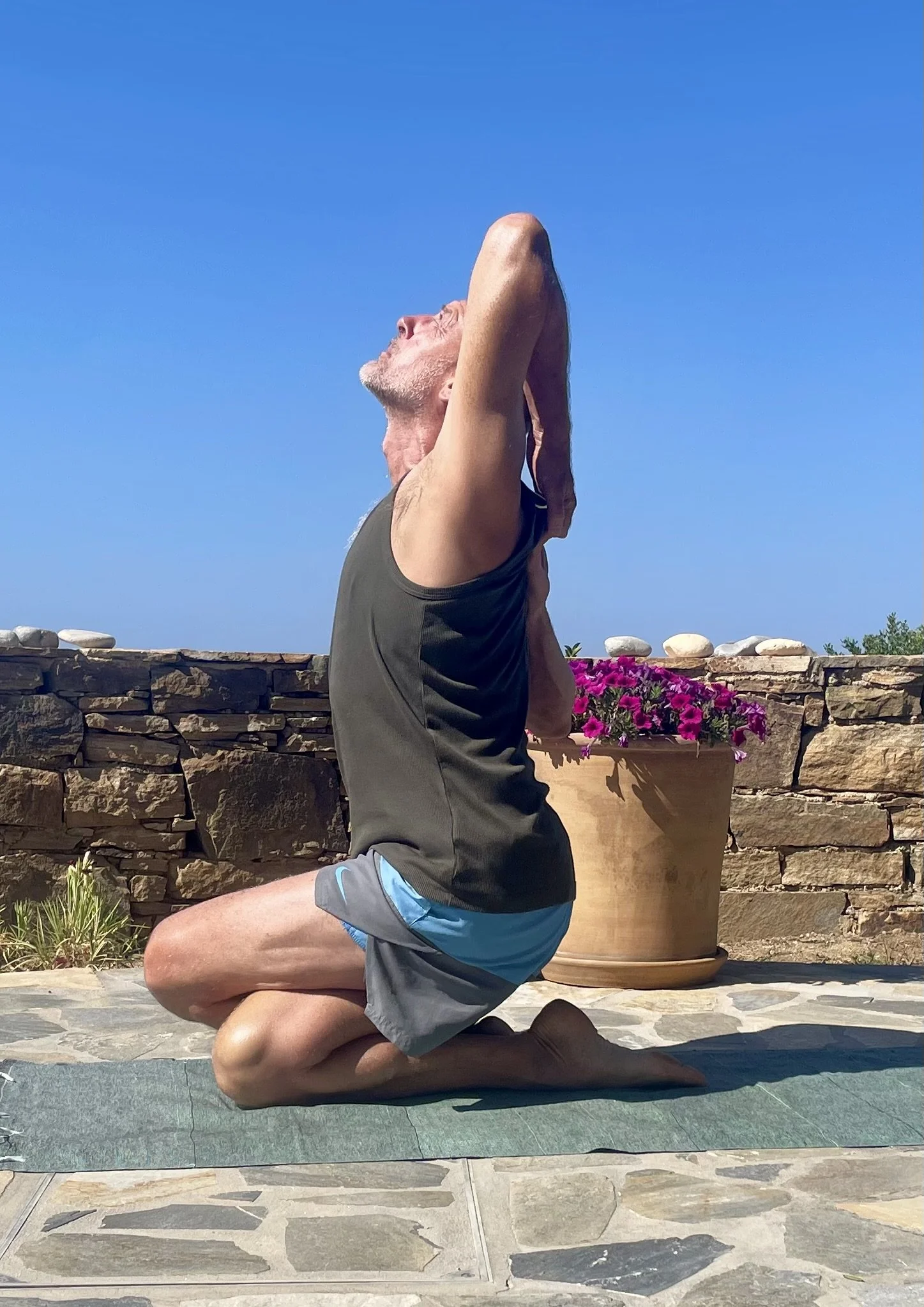
Postures that made me feel I could fall over…when already sitting down. Gomukasana, Naxos, 2026